Do lab grown diamonds glow under UV light?

David Edwards
Published May 22, 2026
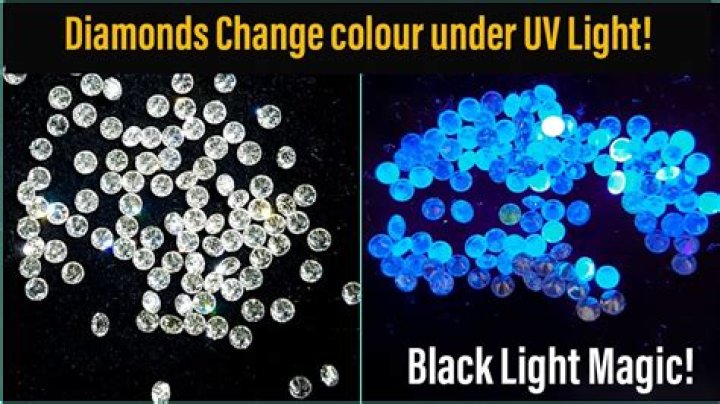
Just like natural diamonds, lab grown diamonds can fluoresce under UltraViolet (UV) light. This remarkable characteristic causes diamonds to glow beautiful colours or a brighter shade of white.
Do lab grown diamonds fluoresce?
As a final note on fluorescence, lab-grown diamonds (other than fancy color lab-grown diamonds) never have fluorescence. We think in time this fact could make fluorescence in a natural diamond a more desirable and valuable trait since it serves as a natural differentiator to lab-grown diamonds.Why are my diamonds glowing under UV light?
Diamonds glow in black lighting due to a phenomenon called fluorescence and roughly 35% of natural diamonds exhibit some degree of this effect. In nature, the presence of certain chemical impurities within the diamond's composition triggers this glowing effect in the presence of an ultraviolet light source.Do fake diamonds glow in UV light?
Ultraviolet Light: About 30% of diamonds will glow blue under ultraviolet lights such as black light. Fake diamonds, on the other hand, will glow other colors or not at all.What color should a diamond be under UV light?
A pure and natural diamond is known to produce a blue glow when exposed to black light. The impure ones have certain chemical impurities that trigger the glow of other colors like green, white, red, and yellow when diamonds are exposed to ultraviolet light.DIAMOND FLUORESCENCE: GOOD OR BAD? And How it Helps You SAVE MONEY When Buying Diamonds!!
What should a diamond look like under UV light?
When exposed to uv light, there will be a diamond glowing different colors. 99% of the time, the glow is blue, but on rare occasions, diamonds glow white, yellow, green, or even red in color. The GIA grades fluorescence in diamonds as None, Faint, Medium, Strong and Very Strong.How do you tell if a diamond is real under UV light?
To test if a diamond is real in a different way, place it under a UV light and watch the reaction. Most diamonds will emit a blue colored glow, but not all of them. Some diamonds do not glow under UV light. For this reason, if the stone does not glow, the results don't necessarily indicate that it's a fake diamond.Does cubic zirconia glow under black light?
Fluorescent test using a regular UV light source will help to distinguish Natural Diamond vs CZ. Cubic Zirconia will not fluoresce unlike Natural Diamonds Fluoresce of about 25% to 30%.Does cubic zirconia glow?
A good way to tell cubic zirconia from a diamond is to look at the flashes produced by the stone when light enters it. Cubic zirconia shines in all colors of the rainbow and has brilliance that is a lot more colorful than that of a real diamond.Do Lab diamonds glow in the dark?
Phosphorescence presents in type iib lab diamonds as a light blue or orange glow after it is exposed to UV light. The glow can last a few seconds to several minutes.Should you buy a diamond with faint fluorescence?
If you're looking at diamonds in the D-F range, we recommend purchasing one without fluorescence. Even faint fluorescence is going to add a dash of blue to your otherwise white stone. Colorless diamonds are some of the biggest fluorescence culprits due to their ultra-clean appearance.Does cubic zirconia fluorescence?
Fluorescence occurs when a gem material is illuminated by radiation of shorter wavelengths with higher energy. A bag of cubic zirconia under LWUV with areas of blue fluorescence that highlights the presence of diamonds. The visible light emitted stops when the source of illumination is turned off.Does Moissanite glow under UV light?
MOISSANITE TESTERS AND UV (Ultra Violet light)To his amazement he found that any UV light worked. Moissanite testers that don't work on some 'difficult' Moissanites work perfectly when the stone is exposed to UV light. If you are buying a Moissanite tester, buy a UV light too, they really are not expensive.