Is it OK to talk in third-person?

Andrew Patterson
Published May 19, 2026
You may be able to calm your anxiety — and actually do better — by simply talking to yourself in the third person, a new study suggests. Researchers found that people create distance between themselves and whatever is causing negative emotions, like fear or anxiety, when they self-talk in the third person.
Is it normal to talk to yourself in 3rd person?
Why talking about yourself in the third person could help control your emotions. A Scientific Reports study indicates that third-person self-talk may constitute a relatively effortless form of self-control. During stressful times, talking to yourself in the third person—silently—could help you control your emotions.Is talking in third person good?
Psychological studies show that thinking and speaking of oneself in the third person increases wisdom and has a positive effect on one's mental state because an individual who does so is more intellectually humble, more capable of empathy and understanding the perspectives of others, and is able to distance emotionally ...What does it mean when you talk in 3rd person?
Third Person Point of View. In third-person narration, the narrator exists outside the events of the story, and relates the actions of the characters by referring to their names or by the third-person pronouns he, she, or they.Is it rude to talk about someone in the third person?
If you are referring to someone who is present in the third present, regardless of the gender, is rude or at least is something you must avoid. If you use pronouns such as he and she during the conversation which that person is present in, it makes them feel that the conversation is about them, not with them.Why You Should Start Referring to Yourself in the Third Person | Ethan Kross
What kind of person talks about themselves in the third person?
Typically, the use of the third person by individuals themselves, called illeism, is associated with egocentrics and oddball characters like rapper Flavor Flav, American Psycho's Patrick Bateman and Jimmy from Seinfeld. When most people talk about themselves, they just say "I."How do you talk to someone in third person?
When you speak or write in the third person, you're talking about someone else, rather than speaking about yourself or directly addressing someone. Third person pronouns include "she," "he," and "they." When a story is told in the third person, it takes the viewpoint of the people being described.Do narcissists talk about themselves in the third person?
The narcissist often talks to himself in third person singular. He feels that it lends objectivity to his thoughts, making them appear to be emanating from an external source. The narcissist's self-esteem is so low that, to be trusted, he has to disguise himself, to hide himself from himself.What is 4th POV?
The 4th person is a new emerging point-of-view. It is a group or collective perspective corresponding to “we” or “us”. A global top-down perspective. The 4th person functions as a collection of perspectives rather than a single objectivity.Why do I talk to myself like I'm talking to someone else?
Most people talk to themselves regularly. This may happen when thinking through ideas, when debating decisions, or when in need of a pep talk. Some people feel that self-talk creates a “presence” around them that makes them feel better. This can help with loneliness.Who speaks third person?
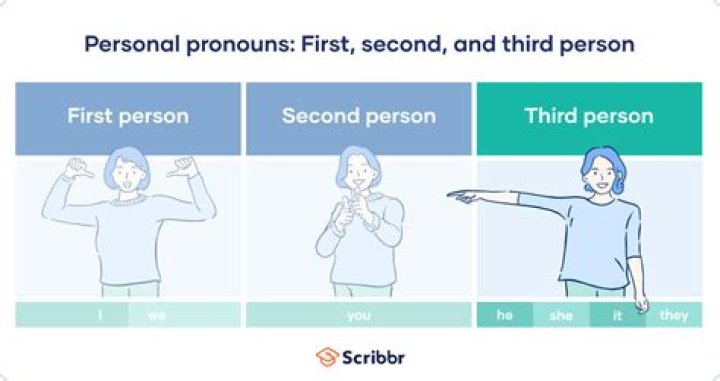
The third-person point of view belongs to the person (or people) being talked about. The third-person pronouns include he, him, his, himself, she, her, hers, herself, it, its, itself, they, them, their, theirs, and themselves.Why speaking to yourself in third person makes you wiser?
Talking to yourself in the third person can make you wiser, new research shows. Those who did it improved in their intellectual humility, perspective-taking, and capacity to find a compromise.What is 6th person point of view?
From a sixth person perspective, one perceives humanity and the Earth system as a dynamic whole consisting of impermanent patterns of material and information flows. It is, according to O'Fallon, the first place where one sees the true simplicity on the other side of complexity.Does 4th person exist?
The term fourth person is also sometimes used for the category of indefinite or generic referents, which work like one in English phrases such as "one should be prepared" or people in people say that..., when the grammar treats them differently from ordinary third-person forms.How many POVS are there?
There are three primary types of point of view:
- First person point of view. In first person point of view, one of the characters is narrating the story. ...
- Second person point of view. Second person point of view is structured around the “you” pronoun, and is less common in novel-length work. ...
- Third person point of view.
What is it called when someone refers to themselves by name?
Glossary of Grammatical and Rhetorical TermsIn English grammar, illeism is the act of referring to oneself (often habitually) in the third person. Also called self-talk. Someone who practices illeism is (among other things) an illeist. Adjective: illeistic.
What is fourth person?
fourth person (uncountable) (grammar) A variety of the third person sometimes used for indefinite referents, such as one, as in one shouldn't do that. (linguistics) grammatical person in some languages distinct from first, second, and third persons, semantically translated by one of them in English.What are the 3 types of third person?
The 3 Types of Third Person Point of View in Writing
- Third-person omniscient point of view. The omniscient narrator knows everything about the story and its characters. ...
- Third-person limited omniscient. ...
- Third-person objective.