What is crashing a schedule?

William Taylor
Published May 19, 2026
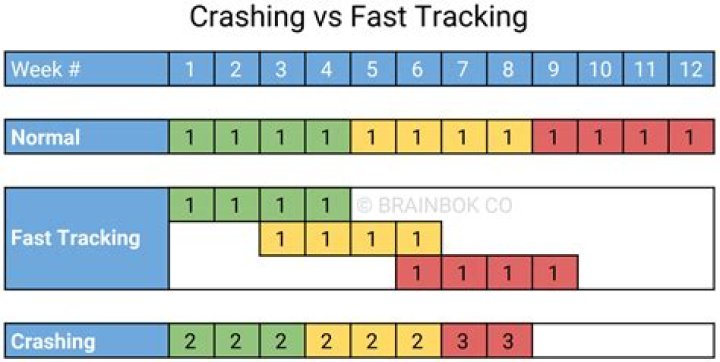
Project crashing is a schedule compression technique in which you bring in additional resources to complete two tasks simultaneously. The Project Management Body of Knowledge (PMBOK® Guide) defines the crashing technique as a way to shorten your project schedule for the least incremental cost.
What does crashing the schedule mean?
“Crashing” the schedule means to throw additional. resources to the critical path without necessarily getting the highest level of. efficiency.How do you crash a project schedule?
- Step 1: Analyze the critical path. ...
- Step 2: Identify all tasks that can be shortened with additional resources. ...
- Step 3: Calculate for each task: trade-off, gain, time reduction. ...
- Step 4: Choose the least costly approach. ...
- Step 5: Provide a crashing budget and updated project baselines to the sponsor.
What is an example of crashing a project?
As a compression technique, crashing concentrates on the project schedule in an effort to accelerate the project's completion date. Plausible examples of crashing include the following: Over-time. Allocating additional resources to specific activities.What are the reasons for crashing a project?
What Are Five Common Reasons for Crashing a Project?
- Project Schedule Delay. If the project is falling behind schedule, you don't have many courses of action to ensure its completion within time limits. ...
- Resource Availability. ...
- Avoiding Future Delays. ...
- Time Bonuses. ...
- Extra Manpower.
What is Crashing the Timeline? Project Management in Under 5
How would you crash or fast track the schedule?
In fast-tracking, activities are rescheduled to be performed partially or fully in parallel, while in crashing, you add extra resources to the activities to finish them early.What is crashing in operation research?
Crashing is a schedule compression technique used to reduce or shorten the project duration by paying for extra resources on the critical path. Crashing analyzes and categorizes activities based on the lowest crash cost per unit time.What activities should be selected for crashing?
The activities can be selected for execution in expedited (crashed) mode based on number of known parameters, such as criticality of activity, extra cost to be incurred and consequent reduction in activity duration due to executing the activity in expediting mode, etc.What are the five steps in project scheduling?
According to the PMBOK Guide (Project Management Body of Knowledge) by the Project Management Institute (PMI), a project management life cycle consists of 5 distinct phases including initiation, planning, execution, monitoring, and closure that combine to turn a project idea into a working product.What is crashing and fast tracking in project management?
In summary, the differences between fast tracking and crashing are: Fast tracking involves the performance of activities in parallel, whereas crashing involves the addition of resources to a project. In fast tracking, there is increased risk, whereas in crashing, there is increased cost.What is crashing PMP?
Crashing Definition. A technique used to shorten the schedule duration for the least incremental cost by adding resources. PMBOK® Guide. When the crashing approach is used, any additional costs associated with rushing the project are reviewed against the possible benefits of completing the project on a faster timeline.When should you stop crashing a project?
The key to project crashing is attaining maximum reduction in schedule time with minimum cost. Quite simply, the time to stop crashing is when it no longer becomes cost effective. A simple guideline is: Crash only activities that are critical.What are the 4 main processes of project management?
Whether you're in charge of developing a website, designing a car, moving a department to a new facility, updating an information system, or just about any other project (large or small), you'll go through the same four phases of project management: planning, build-up, implementation, and closeout.What are the 4 types of project management?
Project managers can be divided into four different types.
- Technical Project Manager.
- Adventurous Project Manager.
- Expert Project Manager.
- Supportive Project Manager.
How do you make a schedule?
6 Steps to Successful Schedules
- Step 1: Define the Schedule Activities. ...
- Step 2: Sequence the Activities. ...
- Step 3: Estimate the Resources Needed for the Activity. ...
- Step 4: Estimating the Duration of Each of the Activities. ...
- Step 5: Schedule Development. ...
- Step 6: Monitoring and Controlling the Schedule.