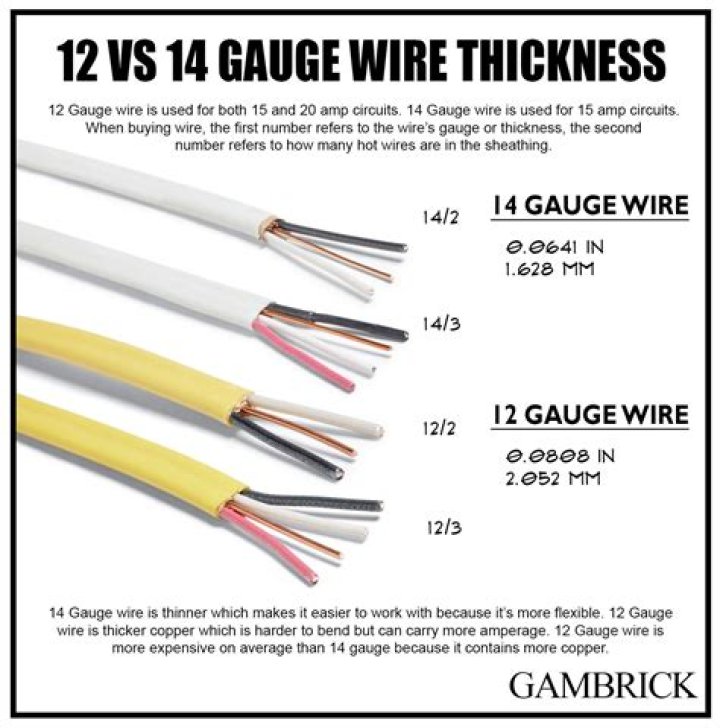
Can you run 12 and 14-gauge wire together?

David Edwards
Published May 20, 2026
Anyway, the first subject is a bit touchy because it makes it difficult to perform an inspection when all of the wires coming into the panel are 12 but many of the circuits have 14 in them too. There is nothing against code mixing wire size for these circuits as long as the OCPD matches the smallest wire.
Can I pigtail 12 and 14 gauge wire?
Yes. It's no problem as long as you can get a good twist on the wires. Pig tails can be 14 gauge since the branch circuit is protected by a 15A Breaker.Is it OK to mix wire gauges?
The short answer is yes, different gauge wiring can be used on a single circuit. It's done all the time when a long portion of a run is upsized to minimize voltage drop, then reduced again to accommodate termination limitations.Can I run 14 gauge wire on a 20 amp circuit?
NEC 240.4(D)(3) states that 14 AWG must be protected at 15A. You can not use 14 AWG anywhere on a circuit that has a 20A breaker.Can you connect 12 gauge wire to 16 gauge wire?
Strip the 12 gauge wire extra long so it goes all the way through the butt connector with the tip extending just a bit out of the metal barrel. Then insert your 16 gauge wire into the other end so it's side-by-side with the 12. That'll give you the build you need for a good crimp.Can I Connect Different Sized Wires?
Can you double up wire?
Yes that is an acceptable solution electrically, but 5 separate conductors will weigh more than one single larger conductor of the same total amp rating. It is the same amount of copper, but a lot more insulation.Can I mix 12 and 18 gauge wire?
NO don't ever mix AWG Wire gauges they are different for a reason and the main reason is amperage. Sure it will work but it's 100% wrong and the #18 gauge wire becomes a fusable link and potential fire hazard. It would be easier to use the #18 wire to pull #12 wire and make it right.Can I use 12 gauge wire with 15 amp circuit?
Because it has even less chance of overheating, 12-gauge wire is also acceptable on a 15-amp circuit.What happens if you use 14 2 wire on a 20 amp circuit?
It is generally NOT okay to have a 20A circuit breaker on a circuit that has any 14 gauge wire -- and most homeowners won't run into the exceptions. If there's any #14 wire anywhere downstream, you must use a 15A breaker to protect that wire.How far can you run 12 2 wire on a 20 amp breaker?
After these distances, the circuit will go over the recommended 3% voltage drop. You can run a 12 gauge wire up to 70 feet on a 15 amp circuit. That number drops to 50 feet if you run 12 gauge wire on a 20 amp circuit.Is it OK to mix 10 and 12 gauge wire?
You haven't said how you will manage the transition from 10 gauge to 12 gauge. If you are thinking of wire nuts in a junction box, then the answer is that you cannot do this safely. The 20A breaker's job is to protect the load wire connected to it. A 12 gauge wire needs a 20A breaker to protect it.Can I use 14 gauge wire for outlets?
14-gauge wire can only be used when wiring an outlet that is on a 15-amp circuit. It is dangerous to use 14-gauge wire for an outlet on a 20-amp circuit. 14-gauge wire is only safe to use when wiring an outlet that is on a circuit 15 amps or lower.When should I use 12 gauge vs 14 gauge?
A 12-gauge wire is required for an outlet circuit that is regulated by a 20-amp breaker while in a case where an overloading light circuit is not required a 15-amp breaker and 14-gauge wire is necessary.How many wires can you pigtail?
The only appropriate way to wire a receptacle in a box with three cables is to use pigtails to connect the receptacles. Never connect more than one wire under a single screw terminal.How many outlets can you put on 14-gauge wire?
If you are using standard two-receptacle outlets, you can wire four of them to a single 15-amp circuit using 14-gauge electrical wire. 14/2 wire on a 15-amp circuit can power 8 receptacles.How far can you run 14 2 wire?
Sizing the ConductorsAs an example, for a 120-volt circuit, you can run up to 50 feet of 14 AWG cable without exceeding 3 percent voltage drop.