What is cytokinesis in short answer?

William Taylor
Published Apr 10, 2026
What is cytokinesis in biology?
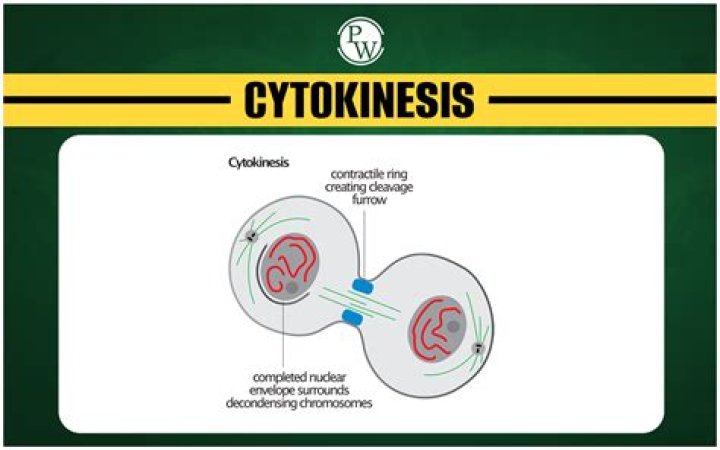
Cytokinesis is the step of the cell cycle in which the cell must faithfully separate the chromosomes and cytoplasm, yielding two daughter cells.Where is the cytokinesis?
Cytokinesis DefinitionCytokinesis is the final process in eukaryotic cell division, which divides the cytoplasm, organelles, and cellular membrane. Cytokinesis typically occurs at the end of mitosis, after telophase, but the two are independent processes.
What is the cytokinesis of a cell?
Cytokinesis is the final step of cell division during which the two daughter cells become physically separated.What is cytokinesis called in plants?
Cytokinesis in plant cellsThese are known as the phragmoplasts. Phragmoplasts are vesicular spindle microtubules formed by Golgi vesicles during telophase on the metaphase plate, carrying vesicles and cellular elements such as cellulose to the new cell wall.
Mitosis and Cytokinesis
What is cell division Class 11?
Cell division is the process by which cells divide and increase in number to produce new cells. The cell that divides is termed as the parent cell and the new cells that are formed are known as daughter cells. A cell comprises organelles and the genetic material – the chromosome.What is Karyokinesis and cytokinesis?
Karyokinesis vs CytokinesisKaryokinesis means the process of division of the nucleus. Cytokinesis means the process of division of cytoplasm. Division. The nucleus gets divided into two daughter nuclei. The cytoplasm, cell organelles and the nuclei divide and are passed on to daughter cells equally.
What is cytokinesis give example?
Spermatogenesis is an example of a process with cytokinesis. It is a cell division process in males in which freshly generated sperm cells are equal in size and content. Oogenesis is an asymmetrical cytokinesis example; in females, it creates a big egg cell with three polar bodies.What is cytokinesis II?
Telophase II and CytokinesisNuclear envelopes form around the chromosomes. Cytokinesis separates the two cells into four unique haploid cells. At this point, the newly formed nuclei are both haploid.